The Rocks That Rewrote Time
Hook
In the 1700s, if you'd asked most educated people in Europe how old the Earth was, many could have given you an exact answer: created on October 23rd, in the year 4004 BC, according to a calculation a bishop had made by carefully adding up generations listed in the Bible. That would make the Earth a little under 6,000 years old at the time — a specific, confident, widely accepted number.
Core Concept
One Scottish farmer-turned-scientist looked at the rocks beneath his feet and became convinced that number couldn't possibly be right — not by a little, but by an almost unimaginable amount.
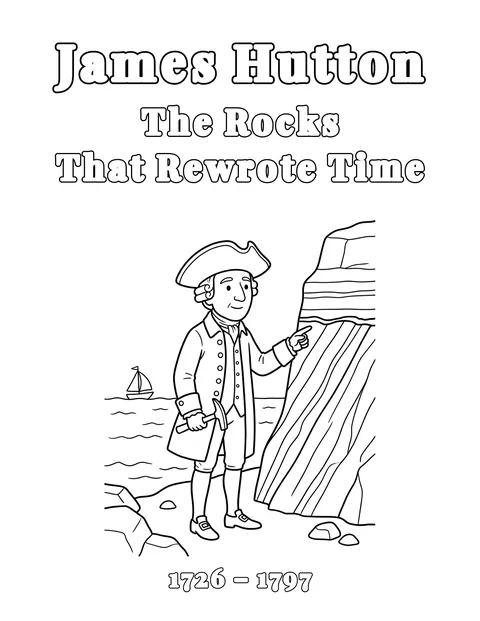
His name was James Hutton, born in Edinburgh in 1726. Hutton trained as a physician but never really practiced medicine, drifting instead into farming, chemistry, and eventually a deep fascination with rocks and landscapes. His core idea, radical for the time, is now called uniformitarianism: the processes shaping the Earth today (rivers depositing sediment, wind wearing down cliffs, volcanoes pushing up new rock) have always worked at roughly the same slow pace. If you want to know how long it took to build a mountain or carve a canyon, you don't need ancient texts. You need to watch how fast those processes happen right now, and do the math.
Everyday Examples
That kind of math adds up fast. A river might deposit a layer of sediment only a fraction of an inch thick in a single year. A cliff might erode back just a sliver at a time, decade after decade. You've probably seen these slow processes yourself without thinking much of it: a stalactite in a cave growing so slowly it looks unchanged over a human lifetime, or a puddle drying into cracked mud, layer by thin layer, after a rainstorm. Multiply that kind of slow, steady change across entire mountain ranges and ocean basins, and Hutton realized you needed vastly more time than a few thousand years to explain what he was seeing in the rock itself.
Foundational Method
In June of 1788, Hutton set out by boat along the Scottish coast with two companions, the mathematician John Playfair and the geologist Sir James Hall, to a rocky outcrop called Siccar Point. What they found there became one of the most famous sights in the history of science: a sharp, angled junction where two completely different types of rock met. Below, steeply tilted gray rock, originally laid down flat under an ancient sea. Above, resting almost horizontally on top of it, much younger red sandstone. For that junction to exist, the gray rock had to have been deposited, buried, tilted upright by immense forces, worn flat again by millions of years of erosion, sunk back underwater, and only then covered by the newer red layer forming on top. One event like that would take a staggering amount of time. This spot showed evidence of the whole sequence, stacked in stone.
Scientist Portrait
Playfair, who was there that day, later wrote down what the moment felt like: "The mind seemed to grow giddy by looking so far into the abyss of time." Hutton had already put his conclusion into words in his paper Theory of the Earth, published that same year, in what became his most famous line: "we find no vestige of a beginning, no prospect of an end." The rocks at Siccar Point were the proof he had gone looking for.
Notice, too, exactly what Hutton did and didn't claim. He never gave a specific number of years for the Earth's age. He simply argued, based on the evidence in the rock, that the processes shaping the planet showed no discernible starting point and no reason to expect an ending, an idea vast enough to make room for the sort of numbers scientists would only pin down centuries later, once entirely new tools existed. Today, geologists have even dated the exact gap in time recorded at Siccar Point: roughly 65 million years passed between the two rock layers forming, in a single unconformity, at a single cliff.
Hutton's own writing style didn't help his ideas spread quickly: by most accounts, his prose was dense and difficult, and many contemporaries struggled to get through it. It was actually Playfair who later rewrote and clarified Hutton's arguments in a separate book, which did far more to popularize the theory than Hutton's own original writing ever managed on its own.
Connection to Your World
You don't need a boat trip to Scotland to notice deep time at work. Look for a place where water has slowly shaped stone: a groove worn into a step, a smooth rounded stone in a riverbed, even the slow buildup of mineral deposits inside a kettle. Each one is a small, ongoing example of exactly the kind of process Hutton insisted you should trust: not ancient assumptions, but careful observation of what's actually happening, right now, at a pace patient enough to reshape a planet.
Wonder Question
Hutton overturned a confidently stated number — 6,000 years — simply by trusting the evidence in the rock over the certainty of the calculation. So here's something worth sitting with: what confidently stated numbers or "settled facts" do we currently accept about the natural world that might, centuries from now, look as far off as 6,000 years does today?
Sources & further reading(3)
Start here
- Siccar Point — Hutton's Unconformity — travel through the "abyss of time" · Scottish Geology Trust
A guide to Siccar Point itself: what Hutton saw there in 1788 and how much time the rocks record.
- James Hutton · The James Hutton Institute
A website about James Hutton: his life, his geology and his Theory of the Earth.
- The Blasphemous Geologist Who Rocked Our Understanding of Earth's Age · Smithsonian Magazine
A magazine portrait of Hutton and the deep time he argued for.
Last checked November 10, 2026 · Spot an error? Tell us