The Idea Darwin Sat On: Natural Selection and the Twenty-Year Wait
Hook
Imagine spending twenty years quietly working on the single biggest idea of your life — testing it, gathering evidence, writing pages and pages about it — and telling almost no one, because you know that the moment you share it, the whole world is going to react.
That's essentially what one English naturalist did, and the reason he waited is just as interesting as the idea itself.
Core Concept
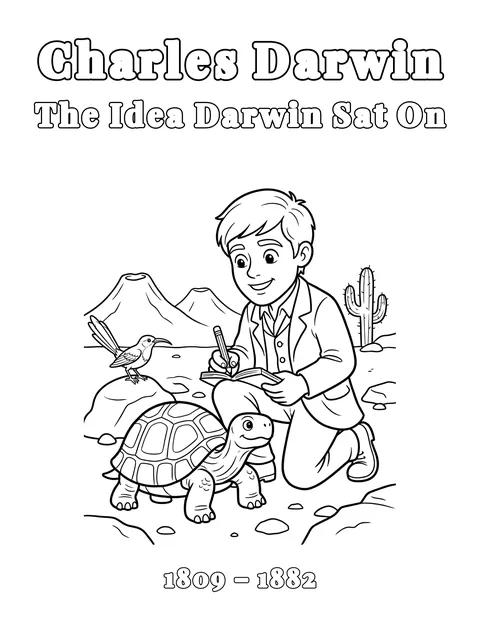
His name was Charles Darwin, born in England in 1809. In December 1831, at just 22 years old, Darwin joined a survey ship called HMS Beagle as its naturalist, setting off on a voyage that would eventually last almost five years and carry him around much of the world, with long stretches spent exploring the coasts and interior of South America. Darwin filled notebook after notebook with observations: rock formations, fossils, and the plants and animals he encountered at every stop, especially on a remote set of volcanic islands off the coast of Ecuador called the Galápagos.
Here's the idea Darwin was slowly building toward, explained plainly: within any group of living things, individuals naturally vary from one another. Some of those variations, which arise by chance, make an individual slightly better suited to survive and reproduce in its particular environment. Those better-suited individuals tend to leave more offspring, who inherit the helpful variation. Repeat that process over countless generations, and a population can gradually change enough to become an entirely different species. Darwin called this natural selection: nature doing something similar to what farmers and breeders had been doing on purpose for centuries, called artificial selection, when they chose which animals or plants to breed based on traits they wanted. Darwin's realization was that nature could produce the same kind of change without anyone doing the choosing on purpose — survival and reproduction did the choosing instead.
Everyday Examples
You've probably noticed natural variation yourself without thinking of it this way: two squirrels with slightly different fur shades, leaves on the same tree that aren't quite identical in shape, dogs of the same breed that still look a little different from each other. Most such differences don't matter much day to day. But in the right environment, even a small difference (slightly better camouflage, a slightly more useful beak shape, slightly faster reflexes) can mean the difference between surviving to reproduce and not.
Foundational Method
Here's a detail about the Galápagos that's often told inaccurately, and it's worth getting right: many popular versions of this story say Darwin was struck by variation in finch beaks and immediately grasped his big idea on the spot. In reality, Darwin barely paid attention to the finches while he was actually there: he didn't even record which specific islands most of them came from, which meant that data couldn't be used as solid evidence later. It was the Galápagos mockingbirds, not the finches, that genuinely caught Darwin's attention at the time; he noticed that mockingbirds on different islands looked distinctly different from one another, and he carefully recorded exactly which island each specimen came from. That mockingbird data turned out to be far more scientifically useful than the finches ever were. Years later, after Darwin returned home, an ornithologist named John Gould examined Darwin's finch specimens and pointed out that they were actually twelve closely related but separate species, information Darwin himself had missed. The now-famous phrase "Darwin's finches" wasn't even coined until 1936, more than fifty years after Darwin's death, and the story only became widely popularized after a 1947 book on the subject. The finches make a great story. They just aren't the story that actually happened.
After the Beagle returned to England in October 1836, Darwin spent the next two years developing the outline of his theory, arriving at the core idea of natural selection by 1838. Then, instead of publishing, he waited. He kept gathering evidence, corresponding with breeders and naturalists, and building an overwhelming case, all while aware that an idea this disruptive to widely held religious and scientific beliefs of his time would provoke enormous controversy the moment it became public.
Scientist Portrait
Darwin's caution wasn't laziness. It was closer to the opposite: a determination to have such an enormous amount of supporting evidence assembled that the argument would be very difficult to dismiss. He corresponded constantly, raised pigeons himself to study inherited variation firsthand, and kept building his case methodically, year after year, long after most people would have either published or given up entirely.
Connection to Your World
You can try a small version of Darwin's habit of noticing variation the next time you're outside. Look closely at a group of the same kind of plant or animal (ants on a sidewalk, leaves on a single bush, birds at a feeder) and see if you can spot small differences between individuals. Then ask yourself: in this exact environment, could any of those small differences actually matter for survival?
Wonder Question
Darwin sat on the single most important idea of his career for about twenty years, patiently building his case in private. But a discovery this significant, it turns out, doesn't always wait patiently for the person who found it first to feel ready — sometimes it shows up in someone else's mailbox instead. So here's a question worth thinking about: if you had an idea you were sure would change how everyone sees the world, would you share it right away, or wait until you could prove it beyond doubt? And what might waiting cost you?
Sources & further reading(4)
Start here
- Charles Darwin: History's most famous biologist · Kerry Lotzof
The Natural History Museum's story of Darwin's life and work, written for everyone.
Go deeper
- The Beagle collections of Darwin's finches (Geospizinae) · Frank J. Sulloway, 1982
The research that showed the finch story is mostly legend, and that the mockingbirds mattered more.
- Darwin's finches (van Wyhe, 2012) · John van Wyhe, 2012
A historian's short account of what Darwin really did with his finches.
- The Complete Work of Charles Darwin Online · John van Wyhe (editor)
Darwin's own books, notebooks and papers, free to read online.
What historians still debate: Did Darwin really hold back his theory for twenty years out of fear? Some historians say the "delay" is a myth; others disagree.
Last checked November 11, 2026 · Spot an error? Tell us