Magnetism: The Invisible Push and Pull
The Hook
Hold two magnets close together with their same sides facing. Push them toward each other. Something invisible pushes back — so hard that your hands shake trying to force them together. Now flip one around. They snap toward each other instantly, with a satisfying click. You haven't touched anything. No wire, no engine, no hand reaching between them. An invisible force stretched through empty space and moved physical objects. This is magnetism — one of the most mystifying and powerful forces in nature. And here's the strangest part: electricity and magnetism are secretly the same thing.
What Is Magnetism?
Magnetism is a force produced by moving electric charges. Inside every magnet, tiny electrons are spinning, and that spinning creates tiny magnetic fields. In most materials, these tiny magnets point in random directions and cancel each other out. In magnetic materials like iron, they can all line up in the same direction, and their combined force becomes powerful enough to pick up paperclips, stick to refrigerators, or move a compass needle from across a room. Every magnet has two poles, called North and South. Opposite poles attract each other; same poles repel. And here is something truly astonishing: if you cut a magnet in half trying to separate its North from its South pole, you just get two smaller magnets, each with its own North and South. You cannot have a North without a South. Ever.
Magnetism All Around You
Earth itself is a giant magnet: its iron core generates a magnetic field that surrounds the entire planet. This field is called the magnetosphere, and it protects life on Earth by deflecting dangerous charged particles streaming from the Sun. Compasses work because their needles align with Earth's magnetic field. Trains in Japan and China use magnetic levitation: powerful magnets repel each other so strongly that the train floats above the track, eliminating friction almost entirely. MRI machines in hospitals use powerful magnets to create images of the inside of your body without any surgery. Hard drives, speakers, electric motors, credit cards: magnetism is everywhere in modern technology.
Connection to Your World
In an electronics kit, you can build an electromagnet: a coil of wire that becomes magnetic when current flows through it. That is Oersted's discovery made real in your hands. The speakers in every phone and computer use a permanent magnet combined with an electromagnet to push air back and forth, creating sound waves. When astronauts on the International Space Station are exposed to solar wind, Earth's magnetic field is what deflects those charged particles and keeps them safe. The auroras (the Northern and Southern Lights) are what happen when some of those particles spiral down along Earth's magnetic field lines and collide with the atmosphere, making it glow.
Wonder Question
If you could make a magnet strong enough, could it lift a person? Are there magnets in space? What would a magnetic field a million times stronger than Earth's feel like?
Sources & further reading(5)
Start here
- History of electricity & magnetism timeline: 1600–1699 · National High Magnetic Field Laboratory
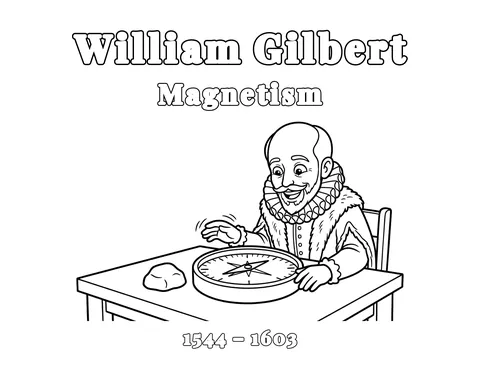
A timeline of magnetism in the 1600s, starting with Gilbert and the word electricus.
- The Great Magnet, the Earth · David P. Stern
A NASA scientist's guide to Gilbert's De Magnete and the Earth as a great magnet.
- Hans Christian Ørsted · National High Magnetic Field Laboratory
A short profile of Oersted and his 1820 discovery that an electric current moves a compass needle, with a video.
- July 1820: Oersted & Electromagnetism · American Physical Society, 2008
The American Physical Society on how Oersted's discovery happened in 1820 and how fast the news spread.
Go deeper
- De Magnete (William Gilbert project) · Lancaster University
Gilbert's De Magnete (1600), the book that said the Earth is a magnet, free to read in English.
What historians still debate: Was Oersted's discovery an accident? Many accounts say so; others say he had been looking for a link between electricity and magnetism for years.
Last checked November 10, 2026 · Spot an error? Tell us