Gravity: The Force That Holds Everything Together
The Hook
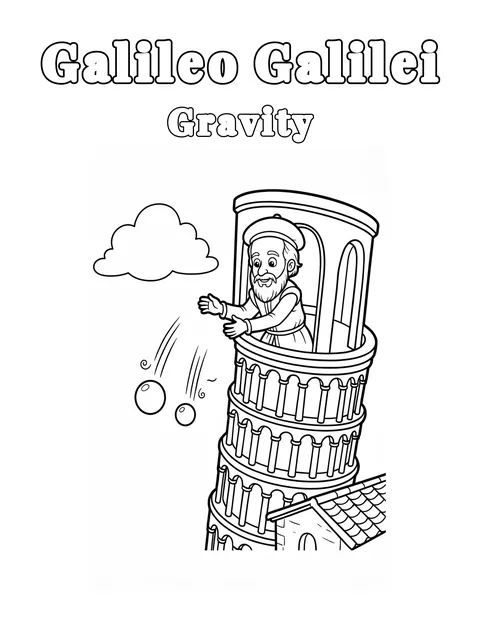
Drop a feather and drop a rock at the same time. Which one hits the ground first? Your eyes say the rock — and most people throughout history agreed. But what if both of them fall at exactly the same speed, and the only reason the feather is slower is because air is getting in its way? That seems impossible. But it's true. Remove the air, and a feather and a bowling ball hit the ground at the same instant. Gravity pulls on everything equally, no matter how heavy. That discovery changed everything.
What Is Gravity?
Gravity is the force of attraction between any two objects that have mass. Every object in the universe — you, your chair, the Moon, the Sun, a grain of sand — pulls on every other object. You are pulling on the Moon right now, and the Moon is pulling on you. The reason you don't fly toward the Moon is that the Earth is enormously more massive, so its pull on you is vastly stronger. The further apart two objects are, the weaker gravity becomes. Gravity doesn't stop — it just gets smaller and smaller with distance, stretching all the way across the universe. It is the weakest of nature's fundamental forces, but it has the longest reach, and on the scale of planets and stars, it dominates everything.
Everyday Examples
Gravity is why you always fall down when you trip, not sideways or up. It's why water flows downhill to fill rivers, lakes, and oceans. It's why the Moon orbits the Earth instead of flying off into space. It's why you can jump but always come back down. It's why planets are round — gravity pulls all the material of a planet equally inward from every direction, creating a sphere. Even the shape of a star, the flow of a waterfall, the arc of a basketball — all of these are gravity at work.
Connection to Your World
Every space mission begins by fighting gravity — rockets burn enormous amounts of fuel to break free from Earth's gravitational pull. But once in space, gravity doesn't disappear. The Moon stays in orbit because Earth's gravity curves its path. The Earth stays in orbit because the Sun's gravity curves ours. Gravity is why the Sun exists at all — billions of years ago, a cloud of hydrogen gas was pulled together by its own gravity until it compressed and heated enough to ignite nuclear fusion. Stars are gravity's greatest creation. When you look at any planet in the night sky, you are seeing gravity sculpted over billions of years.
Wonder Question
If gravity gets weaker the farther away you are, does it ever completely disappear? Is there any place in the universe where there is truly zero gravity?