Zero
Hook
Here is a question that seems almost too simple to ask: how do you write nothing? Not a small amount. Not almost nothing. Exactly, precisely, completely nothing. For thousands of years, this question stumped the greatest civilizations on Earth. The Egyptians did not have a symbol for it. The Greeks argued about whether nothing could even exist as a concept: if there is nothing in a place, is that place real? The Romans built roads, aqueducts, and an empire — and never once used a zero. And yet, without zero, you cannot write the number 10. Or 100. Or 1,000,000. Zero is not just the absence of something. It is one of the most powerful ideas in the history of human thought.
Core Concept
Zero has two distinct jobs in mathematics, and it is important not to confuse them. The first job is as a placeholder: in the number 205, the zero tells us there are no tens. Without it, we couldn't distinguish 25 from 205 or 2005. The second job is as a number in its own right: a quantity that represents nothing, that can be added, subtracted, and operated upon. Three plus zero is three. Seven minus seven is zero. Zero times any number is zero.
These seem obvious now, but they caused genuine intellectual crises. What does it mean to multiply by nothing? Can you divide by zero? (It turns out you cannot, or rather, the result is undefined, because any number times zero is zero, which makes division by zero logically incoherent. Try it: 6 divided by 0 means "how many times does 0 fit into 6?" But 0 fits into 6 infinitely many times, and infinity is a different kind of problem entirely.)
Zero also sits at the center of our number line, flanked by the positive numbers stretching to the right and the negative numbers stretching to the left. It is the balance point, the origin, the place where things shift from having to owing, from above to below, from gain to loss.
Everyday Examples
Zero is everywhere in our number system, so invisibly fundamental that we rarely notice it. Your phone shows 0% battery when it is empty. A temperature of 32°F (0°C) is the point where water freezes. The year 2000 felt special partly because of all those zeros, though, fascinatingly, there is no year zero in the calendar we use (it jumps straight from 1 BCE to 1 CE). Computer science is built almost entirely on zero and one: binary code, which represents all information as sequences of 0s and 1s. The zero on your keyboard is not just a digit; it is the conceptual foundation of digital technology.
Foundational Discovery or Proof
The concept of zero developed gradually across several cultures. The Babylonians had a placeholder symbol for empty positions, but it was not used at the end of numbers and was not treated as a number. The Mayans, completely independently, developed a zero at least 1,700 years ago, one of the most impressive intellectual convergences in history. The crucial breakthrough happened in India.
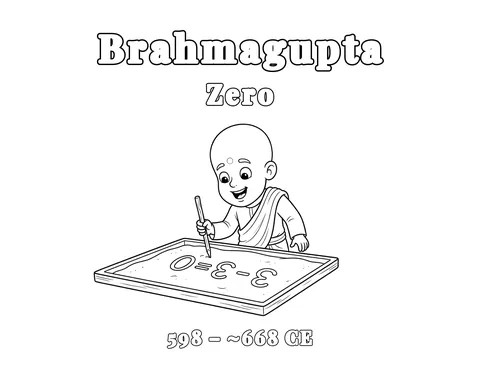
Brahmagupta, in his 628 CE text Brahmasphutasiddhanta, was the first to treat zero as a number with its own arithmetic rules. He defined zero as the result of subtracting a number from itself (n minus n equals zero) and systematically worked out what happens when you add, subtract, and multiply with zero. He attempted to define division by zero, arriving at zero divided by zero equals zero, an answer we now know is incorrect but which shows the ambition of his inquiry.
The Arab mathematician Muhammad ibn Musa al-Khwarizmi (around 780–850 CE), working in Baghdad at the legendary House of Wisdom, was instrumental in transmitting this Indian zero to the wider world. His arithmetic textbook was translated into Latin in the 12th century, and it is from his name that we get the word "algorithm." He also wrote Al-Kitab al-mukhtasar fi hisab al-jabr wal-muqabala, a text whose title gives us the word "algebra." Al-Khwarizmi carried zero, and with it the entire Hindu-Arabic numeral system, into the mathematics that would eventually become modern science.
The Scientist(s) Behind It
Brahmagupta was not just a mathematician. He was an astronomer who needed precise calculation to track the movements of planets. His willingness to confront zero as a genuine number, rather than a philosophical puzzle, came from practical necessity: real calculations require real rules. The fact that he got some of those rules slightly wrong (like division by zero) does not diminish his achievement. He was solving problems that had never been solved before.
Al-Khwarizmi was one of the greatest translators and synthesizers in intellectual history. He did not just copy Indian and Greek mathematics. He reorganized it, extended it, and made it accessible. Working in Baghdad during the Islamic Golden Age (roughly 800–1200 CE), he and his colleagues at the House of Wisdom preserved and transmitted knowledge from Greece, India, and Persia at a time when much of Europe had lost access to it. Without al-Khwarizmi, the Renaissance might have had nothing to rediscover.
Connection to Your World
The next time you write the number 10 — or 100, or 1,000 — pause for a moment. Each of those zeros is doing a job: holding open a place value, telling you that there are no units, or no tens, or no hundreds in that spot. Without zero, you cannot write large numbers. Without large numbers, you cannot describe the distance to the Moon, the number of stars in the galaxy, or the speed of light. Zero is the quiet foundation of all big thinking. And here is a puzzle for you: what is 100 minus 100? What is 7 times 0? What is 0 plus 0? You already know the answers: you are using Brahmagupta's rules.
Wonder Question
Zero is a number that represents nothing — and yet it is one of the most powerful numbers in mathematics. Divide anything by a number close to zero and you get something enormous. Raise zero to the power of zero and mathematicians still disagree about the answer (some say 1, some say it is undefined). And then there is the question of whether zero was invented or discovered. Did zero exist before humans thought of it? Was nothing always there, waiting to be named? Or did zero only come into existence the moment Brahmagupta wrote down the rules for using it? These are not just mathematical questions. They are philosophical ones. What do you think?
Sources & further reading(4)
Start here
- Brahmagupta · MacTutor History of Mathematics
Brahmagupta's life, his 628 book and his rules for zero, including the one he got wrong.
- A history of Zero · J J O'Connor and E F Robertson
A history of zero, from the Babylonian placeholder to Brahmagupta's rules.
- Al-Khwarizmi (790 - 850) - Biography · J J O'Connor and E F Robertson
A scholarly biography of al-Khwarizmi, whose book carried the Indian numerals and zero westward.
Go deeper
- The Classical period: III. Brahmagupta, and the influence on Arabia · Ian G. Pearce
How Brahmagupta's work reached the scholars of Baghdad.
Last checked November 10, 2026 · Spot an error? Tell us